A lot of people who use AI every day have started building their own agents. They give them names like Muse, Grokbot and Duet and hand them small jobs. An agent doesn't need a screen to do its work. It needs an endpoint it can call.
The Agents Are Already Here
Picture a job search tool with a couple of agents attached. One watches for new roles. Another drafts a first pass at fit. Neither needs a kanban board. They need to read your jobs and add new ones, and nobody should have to open a browser tab to copy the results across by hand.
I think of this as an interfaceless job board. It has the same data and the same rules as the app, but something other than a person clicking buttons can use it.
Two Reasons for the Update
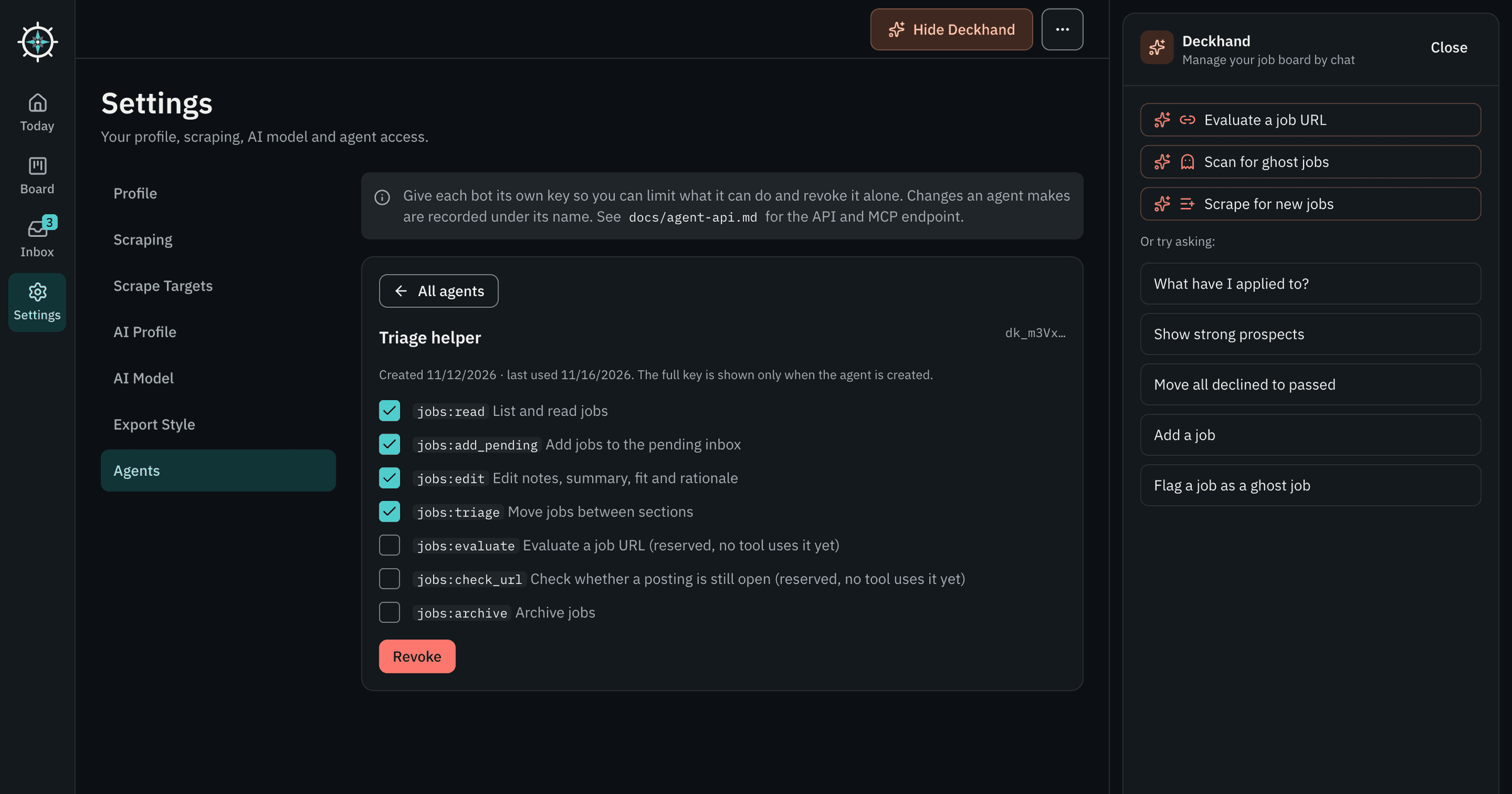
The November update of deckhandAI had two goals. I wanted to redesign the interface and add the features people use every day, like a Today view and inbox triage. I also wanted agents to be real users of the board. If the screens were the only way in, every agent would have to scrape them or borrow a person's credentials, and both are bad ideas. So the board now has a REST API and an MCP server next to the screens, and both follow the same job rules.
What an Interfaceless Board Needs
Take away the interface and you take away the safety rails it provides for free. A confirm dialog is one. The slowness of clicking is another. Those rails have to move into the system.
Each agent gets its own key, so you can revoke one without touching the others. Scopes keep each agent narrow. A read-only agent can look but not touch, and a sourcing agent can add to the inbox and nothing else. Agents can archive a job but never delete or restore one, so the worst a bad run can do is something you can undo. Every change is logged under the agent's name.
The Interface Becomes the Review Step
The screens still matter. They have a different job now. When agents handle sourcing and a first pass, the inbox triage view is where you decide what is worth your time, and the Today list shows what needs your judgment.
See the full set of changes on the updates page, or read the longer write-up, what I shipped in deckhandAI since July. The project is open source on GitHub.
Brian Schwartz
AI Product & Design Leader with 20+ years of experience building teams and shipping enterprise products.