 Open Source · MIT · Self-hosted
Your job search.
Your data. Your AI.
DeckhandAI is an open-source, self-hosted job search tracker with built-in career page scraping, AI-powered application generation, and no vendor lock-in.
New14 PRs shipped in two weeks: URL-based job evaluation, a rebuilt board, and a live public demo→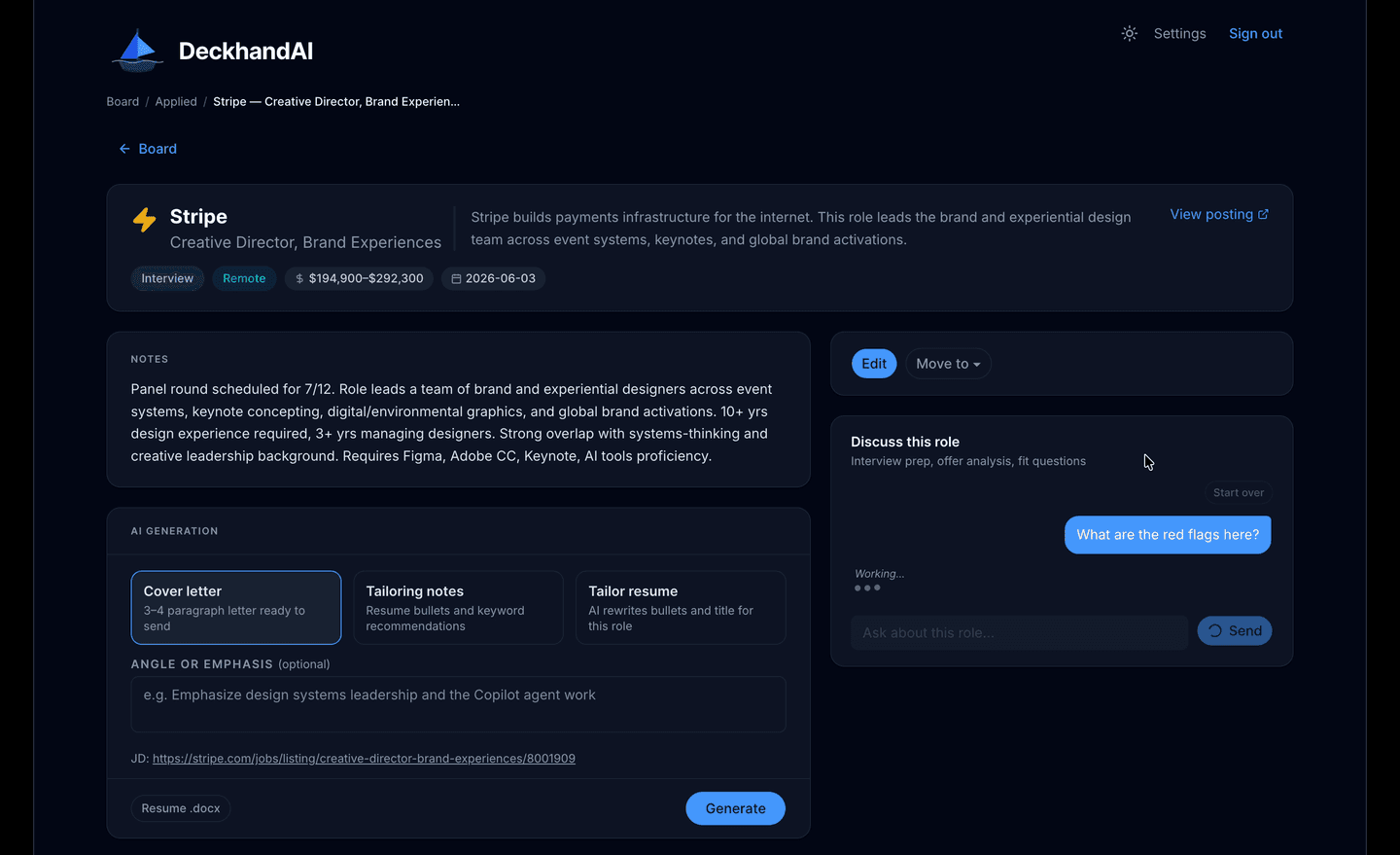
The Problem
ATS filters before humans see you
Most applications are screened by algorithm before a recruiter looks. Your resume needs to match the job description's exact language, which means tailoring every application from scratch, every time.
Pay-to-play job boards
The major boards bury organic results behind sponsored listings. The companies worth targeting often post directly to their own career pages, not to Indeed or LinkedIn. You miss them unless you check manually.
Tracking across everything is chaos
Spreadsheets can't tell you why you applied, which resume version you sent, or what the AI thought of the fit. By week three of an active search, you're guessing.
What It Does
Career Page Scraping
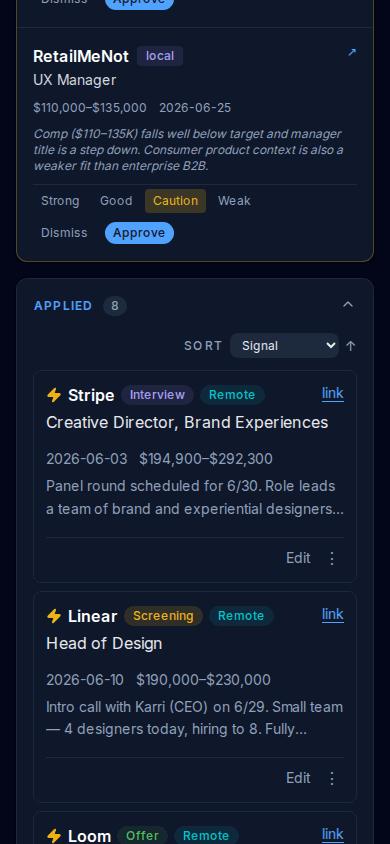
Playwright monitors your target company career pages on a schedule. New roles go to a review queue. You approve before anything hits the board. No noise, no duplicates.
AI Fit Scoring
Every role is scored against your candidate profile: strong, good, caution, or weak, with written rationale. Inline on the board so you know where to spend your time.
Document Generation
Cover letters, tailoring notes, and resume rewrites generated against the live job description. Exports as ATS-safe DOCX built programmatically: proper bullets, tab stops, configurable typography.
Board Management by Chat
An 8-tool assistant lets you manage the board in plain English. Add a job, move it between stages, flag a ghost posting, search for remote roles. Tool status streams in real time.
Any AI Provider
Anthropic, OpenAI, Google Gemini, Grok, Ollama, or any OpenAI-compatible endpoint. Bring your own API key. Nothing is locked to a vendor.
No Database Required
Data lives in a flat JSON file in a private GitHub repository you own. No connection string, no infrastructure cost. Every write is a commit. Version history is automatic.
In Action
Setup
Clone. Configure. Deploy. Under 10 minutes.
Clone & configure
Run node scripts/setup.mjs. It walks you through your GitHub token, data repo, and candidate profile. Three environment variables.
Add scrape targets
Point the scraper at the company career pages you care about. Per-target options handle static HTML, SPAs, iframes, cookie banners, and pagination.
Deploy to Your Site
One click from the README. First launch runs a 4-step onboarding wizard. Under 10 minutes total. Vercel is free, but may have limited capabilities depending on your plan.
Technical
AI provider compatibility
A unified client resolves to any provider from a single config field. Tool calling uses separate code paths for Anthropic and OpenAI message formats. Both feed the same executor. Tested with Anthropic Claude, OpenAI GPT-4o, Google Gemini, and Ollama (local).
Self-host your own instance
MIT license. No subscription, no SaaS, no data you don't own. Everything runs in your Vercel account with your GitHub data.