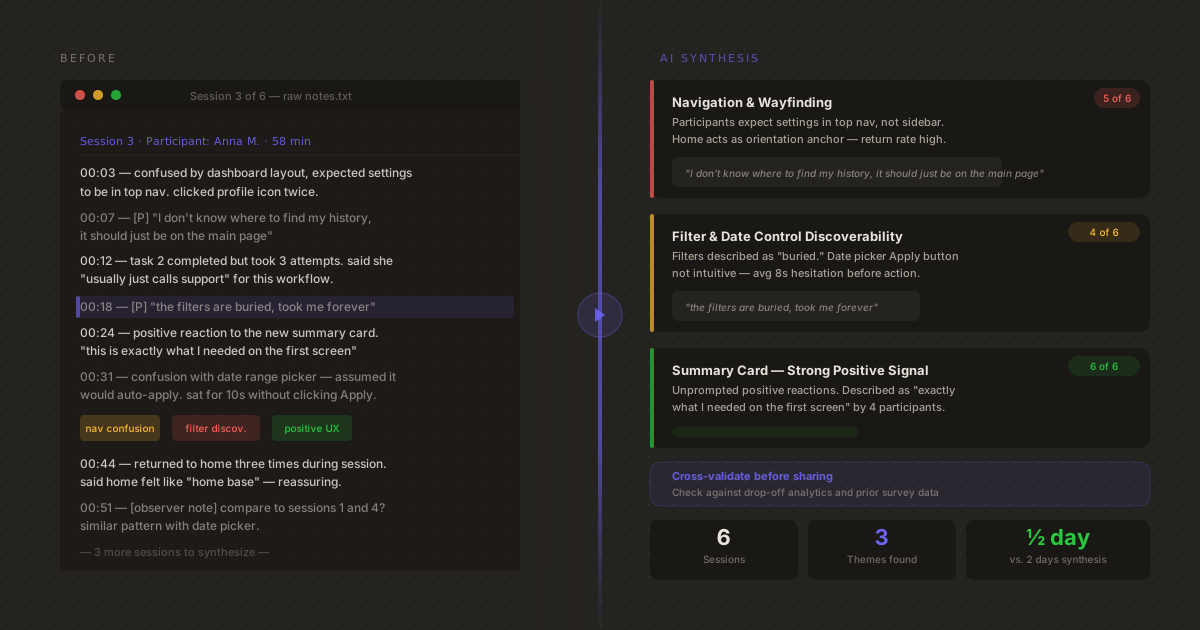
Qualitative UX research has always been expensive in the most honest sense of the word: expensive in time, in people, and in the mental effort required to turn raw conversations into something actionable. That's changing fast, and if you're still running research the way you were three years ago, you're probably leaving a lot on the table.
What It Used to Take
Think back to a standard round of user interviews. Five to eight sessions, sixty minutes each. You needed two people on every call, one to ask the questions and one to take notes, because trying to do both at once means doing neither well. After the sessions came the real work: transcribing recordings, reading through pages of notes, tagging quotes, building an affinity matrix, and sitting in a room with your team trying to find the patterns.
A competent researcher could spend two full days on synthesis alone for a modest study. And that's before writing the report. The whole cycle from first interview to final readout could easily run two to four weeks, assuming no competing priorities.
The matrix was the most painful part. You'd pull quotes and observations into a spreadsheet or sticky notes, group them by theme, argue over whether something was a finding or just noise, and eventually arrive at three to five insights that most of the team already suspected going in. The value wasn't always in the surprise. It was in having the receipts.
What's Different Now
The shift isn't just about speed, though speed is real. It's about what a solo researcher or a small team can now accomplish without a notetaker, without a dedicated synthesis session, and without a week of turnaround time.
Tools like Dovetail have moved from simple repositories to active analysis environments. Upload your recordings or transcripts and it surfaces themes, clusters similar quotes, and builds a searchable library of insights across studies. What used to require a whiteboard and three people now takes an afternoon.
Microsoft Copilot, for teams already inside the M365 ecosystem, has become genuinely useful across the full research workflow. It handles planning, writeup, and synthesis well today. The matrix and key takeaways functionality seems to improve almost daily, and it's becoming a serious option for the synthesis step that used to eat the most time. Researchers at Microsoft have used it to draft discussion guides from a set of assumptions, synthesize notes into first-pass findings, and turn raw analysis into stakeholder-ready summaries. It's not doing the thinking, but it's removing a lot of the formatting and scaffolding work that eats time. (Source)
Marvin is worth knowing if you run moderated sessions. It handles live transcription and auto-tags topics as the conversation happens. You can load your discussion guide ahead of time and it tracks the session in context, so you know which question a quote belongs to. That's a meaningful change from reviewing a raw transcript and reconstructing the conversation after the fact.
Beyond those, the landscape has expanded quickly. Tools like Notably, Looppanel, and Outset.ai cover different parts of the workflow. Conveo and CleverX are moving toward end-to-end platforms that handle recruiting, moderation, and synthesis in one place. If you haven't mapped what's available against your actual workflow recently, it's worth doing.
The Part That Still Requires You
Here's where I want to be direct, because I've seen this go sideways.
These tools are good at finding patterns in what people said. They are not good at knowing whether those patterns matter. That distinction is everything in qualitative research.
When a tool surfaces a theme and says 40% of participants mentioned friction during onboarding, your first question shouldn't be “what do we fix?” It should be “does this hold up?” Check it against your analytics. Does drop-off data show the same friction point? Does a survey you ran six months ago point in the same direction? Qualitative research is most valuable when it explains something you've already seen in the numbers, or challenges something you thought you understood. An AI-generated theme without that cross-validation is a hypothesis, not a finding.
AI-generated themes can also reflect the loudest voices rather than the most representative ones. A participant who described a problem in vivid detail will generate more quotable content than someone who mentioned the same problem briefly. The tool weights toward what's there. You have to weight toward what's true.
This is especially important when the research is meant to challenge a team's assumptions rather than confirm them. If you hand stakeholders an AI-generated insight summary without pressure-testing it yourself, you're not doing research. You're doing a very fast version of confirmation bias.
The human role in this process has shifted, not shrunk. You spend less time transcribing and tagging, and more time interrogating the output. That's actually a better use of a researcher's judgment.
A Note on Data Privacy Before You Pick a Tool
Before you commit to any of these tools for enterprise research, it's worth understanding how each one handles your data. Research sessions often contain sensitive content: unreleased product details, competitive strategy, customer PII, or findings covered by NDA. Not every tool treats that data the same way.
Dovetail states that customer data is not used to train its models. Marvin's default allows your data to be used for LLM training, though you can opt out at signup. For the others, the policies vary and in some cases aren't prominently disclosed, so it's worth reading the privacy documentation directly before uploading anything sensitive.
Microsoft Copilot is worth calling out specifically here. If your organization runs M365 on a private Azure tenant, you get meaningful data isolation that the third-party tools generally can't match. Microsoft's enterprise data protection commitments mean your prompts and responses stay within your tenant boundary and are not used to train public models by default. For teams researching trade secrets, unreleased features, or anything that can't leave the enterprise, that distinction matters. You can conduct and synthesize research inside the same environment where your confidential documents already live, without moving sensitive data to an external platform.
The practical advice: know what you're uploading, read the data processing terms for any tool you're evaluating, and if your research touches IP or competitive information, consider whether a private cloud deployment changes the calculus.
Where This Is Going
The research tools that are emerging now are genuinely impressive. The ones that will matter most are the ones that make it easier to validate findings, not just surface them. The ability to drill into why a theme appeared, trace it back to specific moments in specific sessions, and test whether it holds up across different participant profiles is what separates insight from output.
If you're building a research practice right now, the overhead barriers that used to limit the frequency and scope of qualitative work are lower than they've ever been. A single researcher can run a study, synthesize it, and share findings in a fraction of the time it used to take. That's worth taking seriously, both for what it enables and for the discipline it still requires to do it well.
Brian Schwartz
UX & Product Design Leader with 20+ years building design systems, enterprise applications, and high-performing teams across consulting, enterprise, and startup environments.